Friday, October 11, 2013

Mosaic Homes

Last week, first grade students created a fantasy home, they drew windows, doors, and a unique roof, they then cut their homes into squares and rectangles to create a mosaic style work of art.  They cut 4 - 6 strips and glued them back together with a small amount of space around the tiles they cut.


Mixing Primaries

First grade students learned how to mix primary colors this week using the color wheel.  They learned that mixing red and blue make purple, mixing red and yellow make orange, and mixing blue and yellow to make green.

Students traced oval shapes and turned them into fish, they outlined the ovals with the primary colors so they know where to paint the primaries, the primary colored fish are larger because the primary colors are the most important to mixing colors.


Students mixed colors in their paint trays and painted smaller fish for the secondary colors.


Next week, students will paint the background water, bubbles, and other sea life.

Tuesday, October 8, 2013

Negative space Warm/ Cool painting

Fourth Grade finished their negative space paintings by filling the negative space with their choice of warm or cool colors, students were required to use all three warm or cool colors
Warm colored bird

Cool colored fish and sky

Cool colored panda

Cool colored winter scene

Warm colored cupcake

Students enjoyed the colors and how they are bright against the black positive space and it also shows student knowledge of warm and cool colors

Wednesday, September 18, 2013

4th Grade Positive Negative painting

Fourth grade is working on positive and negative space.  I like to relate positive space with addition (+) and negative space with subtraction. (-) Relating art to other subjects, like math, keeps students engaged and helps connect the dots on a new topic like positive/negative space.

Week 1:  Students practice both positive and negative space on one paper.


Week 2: After students have practice with Positive and Negative space, students sketch out a negative space animal, person, or place, they trace this object with a crayon to create a wax resist.  I always like to trace drawing with crayon when working with watercolor so the colors don't mix into the white space. The students use black watercolor to create the negative space of the object and will finish them off with colored watercolors next week.
Loon

Owl

Tree

Bunny and Cat

House with both positive and negative space

Tap shoes

3rd Grade Kandinsky abstract circles

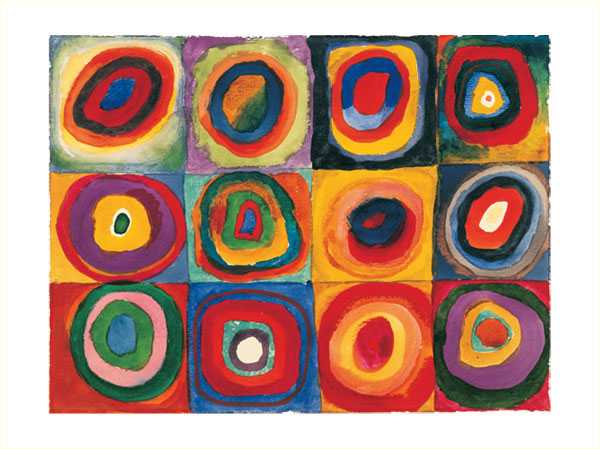
Students started last week by learning about Kandinsky and how much of his work was influenced by music. Students folded a sheet of paper and created different abstract circles, much like the work of Kandinsky.  Each box had to have a different amount of colors and circles with different backgrounds.

This week we are starting our two week (2, 1 hour classes) project of having students cutting and gluing background, circles, organic and geometric shapes onto their paper.


Tuesday, September 10, 2013

This week in art

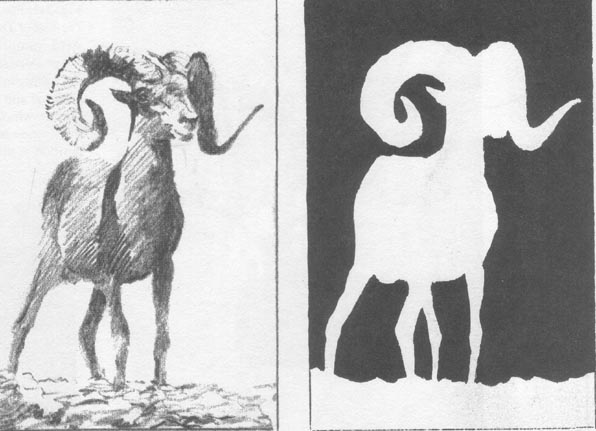
Fourth graders are jumping right into Positive and Negative space this week, showing both a positive space image and negative space image.

Think about positive space like addition, you are adding color to the space (Positive space = +)
in the picture on the left, the ram is in the positive space, in the picture on the right, the ram shape is created using negative space around the ram.


In the picture below, some people see two faces, some see a vase in the middle.  This optical illusion is created using the negative space in between the two faces.


Third Graders are learning about Kandinsky and how he uses circles in many of his artworks.  We discuss the use of a variety of colors and shapes within his work.


Fifth grade is beginning the annual Youth Art Month Flag contest, designing a state flag to represent Minnesota.  This is a fun project because it is an opportunity to talk about art in Minnesota, one of the more notable sculptures that represents art in Minnesota, is the spoonbridge and cherry sculpture in the Walker Sculpture garden in Minneapolis, MN.


Here are a few winners from the past 5 years


Thursday, August 29, 2013

Back to school

Last year, my first full year in the art room, was a learning experience; one of the main issues I saw in every class at one point or another, art caddies.  The art caddy is a place to store all the art supplies for each individual table. Even though the caddies were supposed to look clean and the same for every class, some classes were better at cleaning and organizing than others.  Here is an example of a clean, fresh, sharpened, art caddy; all the supplies are in their place and (in theory) they will all look like this at the beginning and end of each class.

By having this example for my students at the start of the year, and assigning students to check each table; the disappearing pencils, erasers, and messy art caddy problems will vanish!
I also was sure to show how chairs are pushed in and the art caddy is in the middle of the table (below)